The long line of fools
In 1981, DonCarlos Salinas was born in Bakersfield, California, to Donna Armas and Ricardo Salinas. His father had spent time incarcerated in California's Youth Authority system. Drugs were widespread in the family's surroundings, and addiction had become part of the adults' lives. After his parents separated, Ernie Garcia became his stepfather. The family eventually moved to Ridgecrest, California, hoping to escape the drug environment they had known. Religion and community became part of their effort to start over.
Carlos grew up during the rise of Hip Hop, cartoons, and an expanding culture of commercial imagery. He developed an interest in drawing, filling pages with characters and ideas. During his senior year of high school, the family returned to Bakersfield. He graduated, attended community college for about a year, and left home at nineteen.
Over the next two decades, Salinas lived in several cities, including Chicago, Los Angeles, and Riverside, building a life with his wife, Kim, while working professionally as a graphic designer. As computers and the internet transformed the profession, he continued developing an independent artistic practice. His sketchbooks filled with drawings, observations, experiments, and thoughts about life. Some reflected happiness and humor. Others came from frustration, depression, and uncertainty about his place in the world.
In 2020, Salinas began working as a full-time artist. He developed distinct visual styles and systems that allowed him to explore ideas through repetition. Between 2023 and 2025, he created 730 drawings for The Smiley Face Project, a spontaneous daily practice from which characters including Smiley, Grinbud, and Lil Tio continued to develop. Painting offered a slower process, allowing him to refine his techniques, experiment with color, and investigate the possibilities of his materials.
By then, social media had changed what was expected of an independent artist. Making the work was only part of the job. Artists were also expected to document, publish, promote, and continuously produce more. The pressure to remain visible could make it difficult to recognize how much had already been accomplished.
In 2026, at forty-five, Salinas presented OVERTIME, his first solo exhibition, bringing together more than twenty years of work. He had developed an extensive archive, published books, found collectors, and built a growing audience. Yet financial uncertainty, self-doubt, and questions about the future remained. The work had become more established. The artist was still figuring things out.
That same year, a young boy brought markers because he wanted to draw with Carlos. His wife, Kim, reminded him to say goodbye. The boy looked up to him now. Carlos, still uncertain of his own standing as an artist, wasn't quite sure what to make of it.
For centuries, people have devoted their lives to making things without knowing what would become of them. Some were remembered. Most weren't. Salinas had inherited that tradition, contributing what he could during the time available to him.
At forty-five, he was still working, still learning, and still uncertain about what came next.
And apparently, the next fool had already brought his markers.
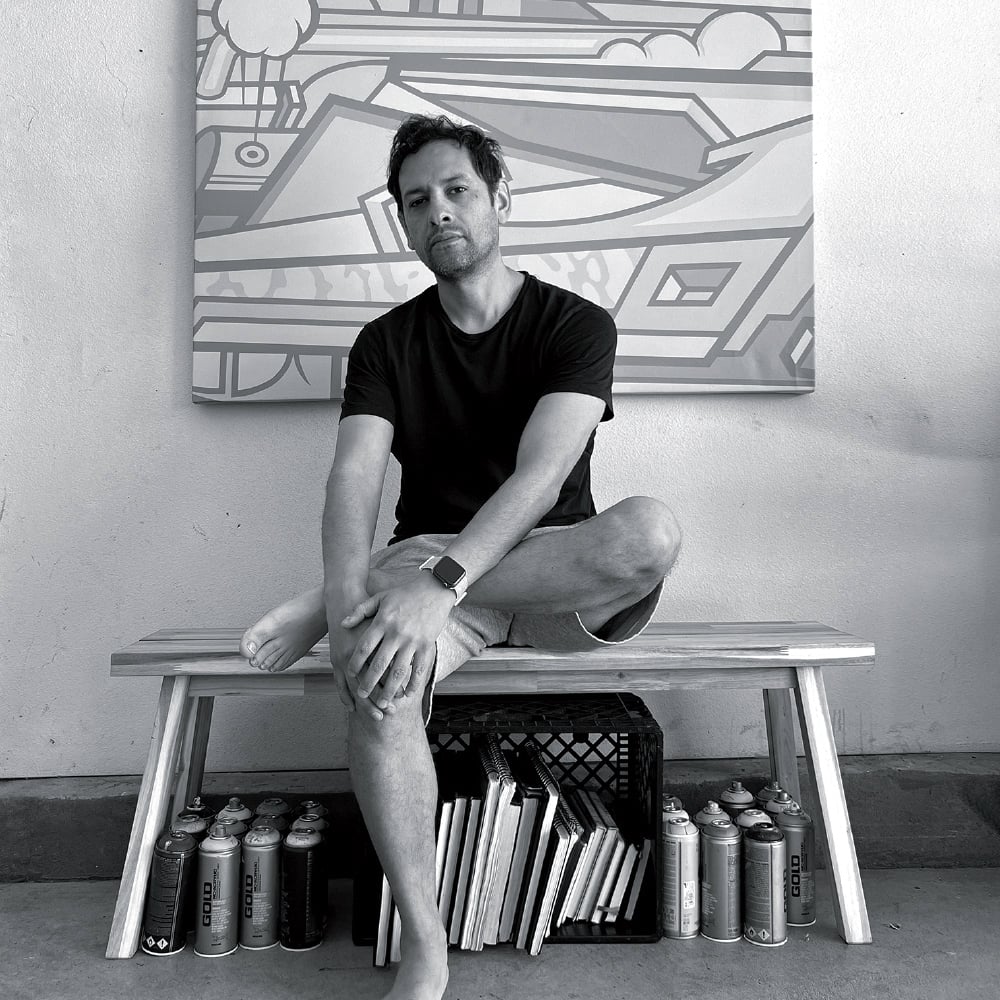
DonCarlos Salinas, Riverside, CA. 2025